

Digital Media — The In-House Growth Engine for CliquePrize®
Digital Media exists inside a simple but uncomfortable truth about modern retail
Most small businesses don’t fail because of bad products. They fail because they run out of cash flow and never build a repeatable system for bringing customers back through the door.
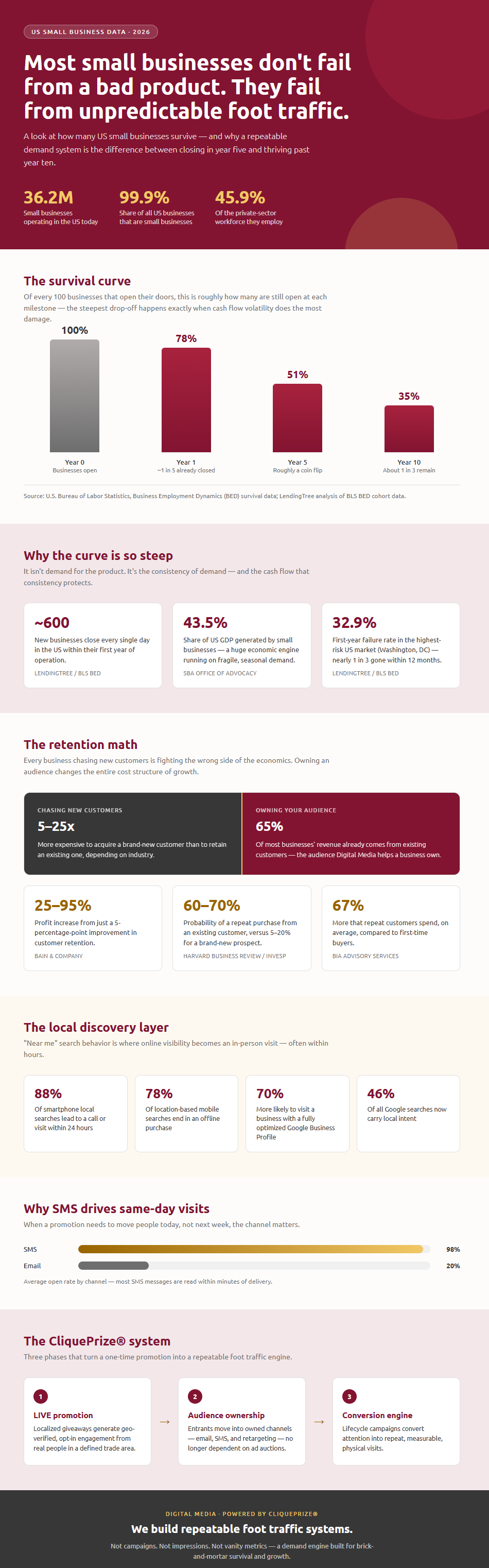
The numbers back this up more starkly than most owners realize. According to Bureau of Labor Statistics Business Employment Dynamics data, roughly 22% of new private-sector businesses in the United States close within their first year. By year five, nearly half — 48.6% — have shut their doors. By the ten-year mark, about two out of every three new businesses, 65.3%, are no longer operating. Put another way: of the roughly one million businesses that open in a given year, more than 200,000 will close before their first anniversary — a pace of almost 600 closures a day.
That attrition isn’t evenly distributed, either. The District of Columbia has the highest first-year failure rate in the country at nearly 33%, while states like Minnesota and Hawaii see roughly 58% of new businesses fail within ten years — still a coin-flip’s worth of survival, even in the best-performing states. And there are currently more than 36 million small businesses in the U.S., accounting for 99.9% of all American businesses, employing close to 46% of the private-sector workforce, and generating 43.5% of GDP. This is not a niche problem. It is the backbone of the American economy running on a structurally fragile foundation.
The dominant cause of failure is not lack of demand — it’s inconsistent demand and inefficient customer acquisition. A business can have a great product, a loyal handful of regulars, and a five-star reputation, and still collapse because the flow of new and returning customers through the door is unpredictable from month to month.
That is the problem Digital Media was built to solve.
We Are Not a Traditional Marketing Agency
We are not a traditional agency optimizing for clicks or impressions. We are a brick-and-mortar demand system designed to create predictable, repeatable foot traffic that sustains physical businesses the way big box retail does.
Big box retailers don’t rely on one-time marketing campaigns. They rely on continuous loops of:
- Constant customer acquisition
- Behavioral tracking
- Promotions tied to location
- CRM-driven re-engagement
- Aggressive retargeting across channels
- Engineered repeat visits
Digital Media takes that same system-level thinking and makes it accessible to local businesses that normally operate without it — businesses that, statistically, are far more likely to fail in the exact years when a big box competitor would be doubling down on customer retention infrastructure.
Full-Stack, In-House Capabilities Built for Physical Growth
Digital Media operates as a unified in-house performance marketing engine, not a collection of disconnected services. We don’t run paid media to push people directly toward a store visit — that’s a high-friction ask for someone who has never heard of the business. Instead, every acquisition channel below exists to do one thing: drive entries into a localized CliquePrize® giveaway, which captures a real, opt-in local marketing list. From there, that list — not the ad platform — is what gets people through the door, via email and SMS offers.
PPC (Pay-Per-Click Advertising)
We capture high-intent demand at the exact moment people are searching for services, experiences, and locations near them — but unlike standard PPC, the click is not the finish line. Every ad is built to funnel a searcher into a localized CliquePrize® giveaway, where entry requires opting in with real contact information. That single step converts an anonymous click into a geo-verified, opt-in local marketing record the business now owns. This matters more than ever: local, “near me” intent now represents a huge and fast-growing share of all search activity, which means PPC has never been a cheaper way to fill a local giveaway with real, nearby prospects.
SEO (Search Engine Optimization)
SEO is treated as long-term infrastructure, not content volume. We focus heavily on local search behavior, “near me” intent, Google Maps visibility, and category dominance. Unlike the paid channels, organic search traffic is already close to a decision, so it’s the one acquisition layer we do point straight at the business — directions, calls, bookings — rather than routing it through a giveaway first. The stakes here are enormous: studies tracking mobile local search behavior consistently find that roughly three-quarters to nearly nine in ten smartphone users who conduct a local search visit or call the business within 24 hours, and a majority of those location-based mobile searches end in an offline purchase. A fully optimized Google Business Profile alone makes customers meaningfully more likely to trust, visit, and buy from a business compared to one with an incomplete listing. The goal is not traffic — it is location discovery at the exact moment someone is ready to decide.
Paid Social
Paid social is engineered as a proximity-based list-building layer. We target users based on geography, interests, and behavioral signals that indicate local intent, and creative is built around one call to action: enter the giveaway. A scroll-stopping ad doesn’t need to convince someone to visit a business they’ve never heard of — it only needs to convince them to enter a prize drawing tied to that business. That’s a dramatically lower-friction ask, and it’s what makes CliquePrize® campaigns so effective at converting cold social traffic into a warm, opted-in local list.
Email Marketing
Email becomes the retention and reactivation layer of the system. Instead of generic newsletters, we build segmented lifecycle campaigns: first visit → second visit → loyalty loop. This isn’t a nice-to-have. Research consistently shows that existing customers already generate the majority of most businesses’ revenue — often 65% or more — and that they spend meaningfully more per visit than first-time buyers. The objective is to systematically turn one-time visitors into recurring customers instead of leaving that transition to chance.
SMS Text Messaging / Mobile Marketing
SMS is the closest digital equivalent to walking into a store and speaking directly to a customer. Text messages are opened at rates near 98%, compared to roughly 20% for email, and are typically read within minutes of delivery. We use SMS for immediate activation: flash offers, event reminders, win notifications, and time-bound incentives that directly drive foot traffic within hours, not days.
Programmatic Display
We deploy geo-fenced programmatic ads that follow users after they’ve entered a giveaway or engaged with a campaign but haven’t yet converted the offer into a visit. This is digital “reminder marketing” that mirrors how big box retailers stay top-of-mind across the web — reinforcing the email and SMS offers already in someone’s inbox, rather than trying to close a stranger cold.
Website Design
Websites and landing pages are built as conversion machines, not digital brochures. For paid traffic, the primary conversion is a fast, frictionless giveaway entry; for organic and direct traffic, the page is designed around physical action — directions, booking, RSVP, or redemption. Speed, clarity, and mobile-first behavior are non-negotiable, especially given that the majority of local searches now happen on mobile devices and most conversion decisions happen within seconds of a page loading.
A/B Testing and Optimization
Everything is tested. Offers, landing pages, timing, messaging, and creative are continuously refined. The goal is not incremental digital engagement — it is measurable lift in real-world visits.
Direct Mail
We integrate physical mail as part of the same ecosystem. Direct mail is not separate from digital — it is reinforced by it. A postcard becomes more powerful when it is supported by SMS reminders, email follow-ups, and retargeting ads working the same audience from multiple directions at once.
The Core System: LIVE Promotion → Owned Audience → Repeat Visits
Most agencies operate in campaigns. Digital Media operates in systems.
At the center of this system is the LIVE promotion engine powered through CliquePrize®.
Phase 1: LIVE Promotion (Acquisition)
We launch localized giveaways and promotions designed to attract real people in specific geographic zones. These are not passive ads — they are participation-based campaigns that generate opt-in engagement.
Instead of buying cold traffic, we create incentive-driven interaction where users willingly engage with local businesses in exchange for entry, rewards, or experiences.
This produces:
- Geo-verified users
- Opt-in contact data
- High-volume local engagement
- Immediate awareness within defined trade areas
Phase 2: Audience Ownership
Once users enter through a LIVE promotion, we transition them into owned channels: email, SMS, and retargeting pools.
This is the most important shift in the entire system. At this point, the business is no longer dependent on algorithms or ad auctions — it has an audience it can directly reach, on its own terms, for the cost of a text message or an email send rather than an ad bid.
This shift matters economically far more than most business owners realize. Acquiring a brand-new customer typically costs somewhere between 5 and 25 times more than retaining an existing one, depending on the industry. Once a business owns its audience instead of renting it from an ad platform, the entire cost structure of growth changes in its favor.
Phase 3: Post-Promotion Conversion Engine
This is where most agencies stop. We begin optimization.
We deploy structured lifecycle campaigns designed to convert attention into behavior:
- First-visit incentives
- Urgency-based offers
- “Near you today” messaging
- Event invitations
- Reactivation campaigns for non-visitors
The goal is not engagement. The goal is repeat physical visitation — and the math strongly rewards getting this phase right. A modest 5-percentage-point improvement in customer retention has been shown to increase business profits by anywhere from 25% to 95%, because retained customers cost less to serve, spend more per visit, and refer new customers at no additional acquisition cost.
Why This Works: Borrowing the Big Box Retail Playbook
Large retail chains succeed because they operate on repeatable demand systems, not isolated marketing efforts.
They don’t ask, “Did this campaign perform?”
They ask, “Did we increase visits per customer per month?”
They build systems that:
- Capture every customer interaction
- Track behavior across time
- Continuously re-engage audiences
- Optimize promotions based on real-world traffic data
- Reduce dependency on any single acquisition channel
Digital Media applies that same philosophy to small businesses that historically lack the infrastructure to do it.
The key difference is scale and accessibility:
- Big box retail builds proprietary systems and large CRM teams.
- Digital Media builds a plug-in demand engine for local brick-and-mortar operators.
This is what most small businesses never get access to. They rely on sporadic ads, seasonal promotions, or word of mouth. That creates volatility — and volatility kills cash flow. Our method replaces volatility with repeatable demand cycles.
The Economic Reality: Why Most Small Businesses Fail
The failure rate of small businesses is not primarily a product problem. It is a cash flow consistency problem.
When acquisition is unpredictable:
- Revenue becomes unpredictable
- Staffing becomes unstable
- Inventory planning breaks down
- Rent becomes riskier
- Cash reserves are eventually exhausted
This is precisely why the failure curve is so steep in the early years and never fully flattens: a business doesn’t need one successful marketing campaign, a viral moment, or a great opening week. It needs a system that produces predictable weekly foot traffic, repeat customers, and measurable return visits, month after month, regardless of season or economic mood. Without that, even genuinely profitable businesses can fail during slow cycles simply because they run out of runway before demand recovers.
Digital Media exists to stabilize that cycle — to be the difference between a business that survives its fifth year, when nearly half of its peers have already closed, and one that becomes part of the roughly one-third that make it past ten.
Beyond CliquePrize®: Full-Service Brick-and-Mortar Growth
While many clients use CliquePrize® as the lead generation layer, Digital Media also operates independently for brands that need pure digital infrastructure.
For example, with clients like Lequire Gallery, we focus on:
- SEO strategy for local discovery
- Conversion-focused website architecture
- Brand positioning in local search results
- Sustained organic visibility
In these engagements, the mechanism changes — but the outcome does not. The goal is always the same: drive real people into physical locations.
The Mission: Make Foot Traffic Predictable
Digital Media is not trying to reinvent marketing language. It is trying to solve a structural problem in local commerce.
If big box retail wins by engineering repeat visits at scale, then small businesses need access to similar systems — but simplified, automated, and affordable.
That is what we build.
Not campaigns. Not impressions. Not vanity metrics.
We build repeatable foot traffic systems for brick-and-mortar survival and growth.
Ready to get started? Contact CliquePrize® and find your local US Sales Rep to set up your first local lead generation for only $29!
Sources: U.S. Bureau of Labor Statistics (Business Employment Dynamics); U.S. Small Business Administration Office of Advocacy; LendingTree analysis of BLS BED data; Bain & Company; Think with Google; industry research on local search and SMS marketing performance.
.